Media freedom through transnational lenses: insights from Montenegro and North Macedonia
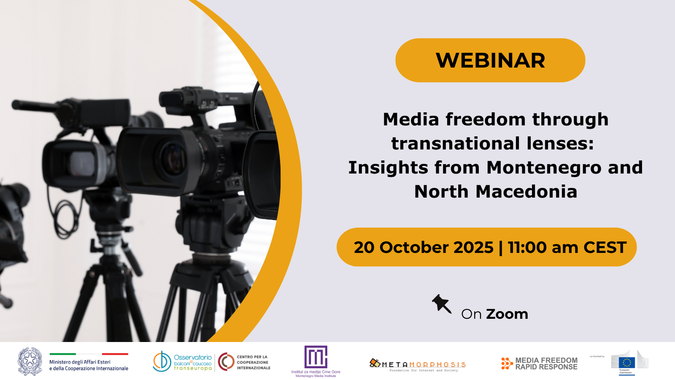
This webinar presents the findings of two shadow reports assessing the state of media freedom in Montenegro and North Macedonia, highlighting progress, ongoing challenges, and recommendations for EU and national stakeholders
Montenegro has recently advanced its media legislation, strengthening public broadcaster independence, enhancing transparency, and promoting self-regulation. Yet, challenges remain: key institutions remain vulnerable to political influence, law implementation is inconsistent, and foreign interference continues to pose risks.
In North Macedonia, improvements such as reduced violence against journalists and legal reforms coexist with persistent issues, including disinformation, political and economic pressure, weak regulation, particularly for online media, and declining public trust. Foreign interference and negative rhetoric from officials add to the fragility of the media environment.
Montenegro and North Macedonia are both candidates for EU accession; for this reason, this webinar aims to explore the current media landscape in both countries from a transnational perspective, understanding its implications for the wider EU integration process.
Opening remarks
Embassy Counsellor Botzios Thomas, Adriatic and Western Balkans Unit at the Italian Ministry of Foreign Affairs and International Cooperation
Speakers
Maja Sever, European Federation of Journalists
Olivera Nikolic, Montenegro Media Institute
Zoran Richliev, Metamorphosis Foundation
Massimo Moratti, OBC Transeuropa
Moderator
Serena Epis, OBC Transeuropa
To attend the webinar, register at this link
This webinar is produced as part of the Media Freedom Rapid Response, a Europe-wide mechanism that tracks, monitors, and responds to violations of press and media freedom in EU Member States and candidate countries. It also draws on the research and advocacy activities supported by the project “Transnational Advocacy for Freedom of Information in the Western Balkans - ATLIB 2” co-funded by the Italian Ministry of Foreign Affairs and International Cooperation.
